About the Journal

The Critical Journal of Social Sciences is a double-blind peer-reviewed academic journal that publishes original research in the social sciences. The journal provides an international platform for critical and interdisciplinary scholarship, with a particular interest in research addressing social, political, and cultural processes in the Global South.

The journal welcomes original theoretical and empirical research articles, book reviews, and working papers from all areas of the social sciences and related interdisciplinary fields.

CJSS follows a quadrimestral publication schedule, with issues released in February, June, and October.

Manuscripts are accepted throughout the year on a rolling basis. However, each issue has a specific submission deadline. Authors are encouraged to consult the journal's Announcements section for the current Call for Papers and the submission deadline for the next issue.

All published articles are assigned a Crossref DOI and are made immediately available through Open Access. No Article Processing Charges (APCs) are applied to regular issues.

As an independent, non-profit Open Access journal, CJSS relies on the voluntary work of its editorial team. Voluntary donations via PayPal are warmly welcomed to help support the journal's editorial activities, DOI registration, web hosting, and long-term sustainability

Donate here via PayPal

Announcements

Current Issue

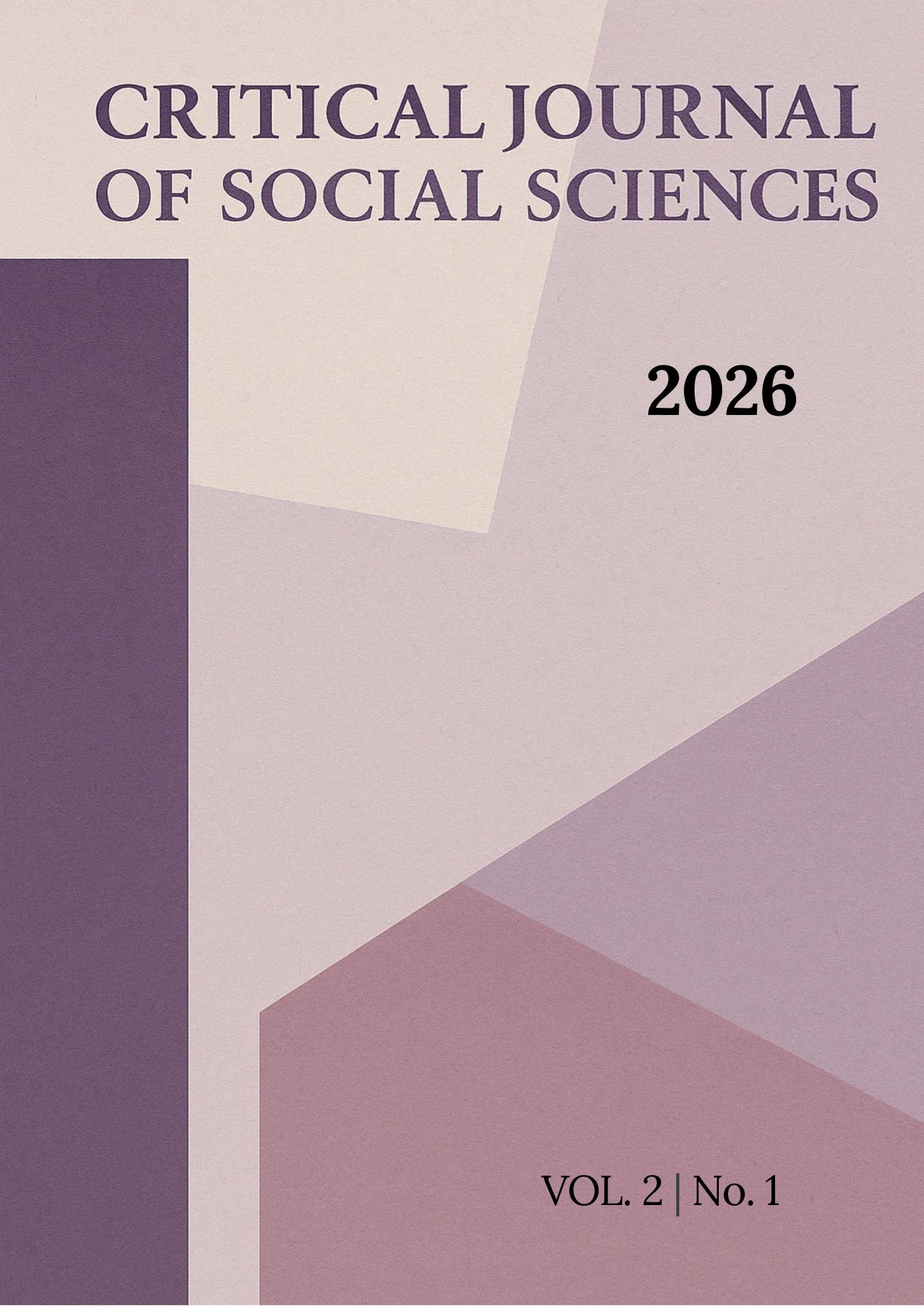
Vol. 2 No. 1 (2026): Critical Journal of Social Sciences
					View Vol. 2 No. 1 (2026): Critical Journal of Social Sciences

Volume 2, Issue 1 (2026) of the Critical Journal of Social Sciences presents seventeen original research articles covering a broad range of topics within the social sciences, including sociology, education, public policy, governance, development, culture, and interdisciplinary perspectives. All articles have undergone peer review and are published under the journal's open-access policy.

Published: 2026-07-15

Articles

View All Issues

It is with great enthusiasm that we introduce the Critical Journal of Social Sciences to the world, aiming for it to serve as a small window—especially considering the proliferation of academic journals in recent years—through which to interpret the world with a critical perspective. However, it must be noted that having a critical perspective does not automatically mean identifying and highlighting merely negative aspects of a subject of study. Rather, applying a critical view to a social phenomenon fundamentally means acknowledging that this phenomenon is a complex process and, therefore, can (and should?) encompass diverse and often contradictory perspectives and interpretations.

At the Critical Journal of Social Sciences, we have set out to carve a path among more established journals with formidable editorial track records because we believe there is a need for more platforms of social critique from which to fight against windmills. While we are aware of our limited resources, we must not lose our appetite for engaging in constructive discussions and understanding the social complexity of both global and local realities in diverse regions, especially those that fall outside the often restrictive parameters of the Global North.

Consequently, we aim to launch a first issue founded on two fundamental pillars: critical spirit and interdisciplinarity. The journal accepts a wide range of topics within the broad field of social sciences, including but not limited to disciplines such as Archaeology, Psychology, Geography, Economics, History, Law, Politics, Education, Sociology, Arts, or Language Studies. Therefore, we welcome submissions throughout the year, irrespective of special issues that may be announced, in the form of original articles, theoretical reviews, preliminary project results, debates, book reviews, and more. Special consideration will be given to the work of doctoral candidates or recent graduates, as well as early-career researchers. We also especially encourage submissions from regions in the Global South, without restricting or in any way conditioning the acceptance of manuscripts from other regions.